
Coenzyme Q10, ubiquinol – do we need it?
Absolutely – for every movement, every heartbeat and every thought. And that applies to all multicellular organisms, including, of course, humans. It is a component of the engine that powers everything: the mitochondria. That is why it is also called ubiquinone, because it is ubiquitous – in other words, it occurs ‘everywhere’.
All cells produce it too, and we live on it – so what’s the problem? One problem is that its levels decline with age. We have measurements from many organs; in the heart, for example, at the age of 40 we still have 70 per cent of the original amount, whilst by the age of 80 we have barely half that amount. This reduces our physical performance, which, as we all know, declines with age.
Another problem is the widespread use of cholesterol-lowering drugs (statins), which many people take to protect their blood vessels from heart attacks. These drugs also reduce production, even without the effects of ageing.
So what exactly are the ubiquinone and ubiquinol variants?
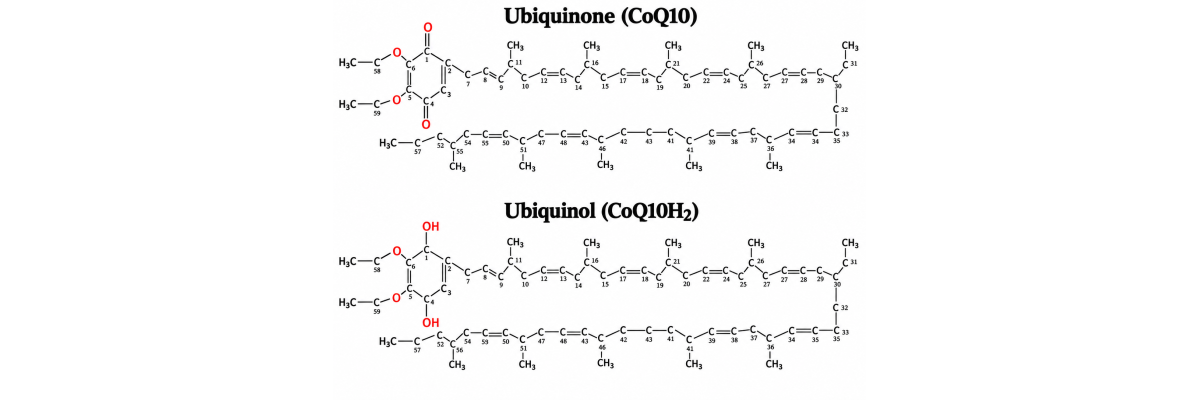
The image above shows their structure. It consists of an ‘endlessly’ long chain (C59) with a functional group (quinone) at the very end, which can transport electrons. The mitochondria – our powerhouses – need this to generate energy. In the process, CoQ10 is constantly being charged and discharged with electrons. When charged, it is called ubiquinol; when discharged, it is called ubiquinone.
When you consume it in food (or as a supplement), it is all converted into ubiquinol in the gut. This process is quicker if you consume it in the form of ubiquinol. That is why ubiquinol is often referred to in advertising as the ‘active’ form. This isn’t entirely accurate, as both forms are ‘active’. However, it is absorbed slightly more effectively. That is the difference.
Unfortunately, the ubiquinol in these preparations is expensive and rather unstable. It oxidises easily and then spontaneously converts to ubiquinone. We need elaborate packaging to protect it, yet it still has a short shelf life and comes at a high price.
Alternatively, we can dissolve it in an oil containing antioxidants. Antioxidants – specifically vitamin E – convert ubiquinone into ubiquinol. The stronger antioxidant (vitamin E) reduces the weaker one (coenzyme Q10) and converts it into the more effective ubiquinol. This is precisely what is demonstrated by Patent US9949938B2 . Here, standard ubiquinone was combined with tocotrienol vitamin E derived from annatto. As a result, 89 per cent was converted to ubiquinol (ranging from 74 per cent to 100 per cent). This was confirmed by HPLC analyses. By doing it this way, one obtains the desired, expensive ubiquinol in a simpler manner.
That is exactly what TRICUTIS’s new CoQ10 Olive does. Although we add Kaneka Ubidekarenon, we are able to extract between 74 per cent and 100 per cent ubiquinol. An added benefit is that vitamin E – in the form of tocotrienols – is also present.
Why extra virgin olive oil (EV) in particular?
Because there is this study, which describes in detail how even small amounts of CoQ10 in olive oil were able to increase blood levels by 73 per cent or even 170 per cent within two weeks. One reason for this is that the dissolved CoQ10 is more easily absorbed and the vitamin E in olive oil has already been converted to ubiquinol.